
Public school never served me well as a child. (To learn more about it, visit my post “The Journey of Education”) The education didn’t challenge me the way it should have, both teachers and students decreased my self-esteem and mental health, and I learned nothing. When I left, my parents began paying for alternative schooling, which was expensive enough as it is, but all the while they were still paying tax dollars to the school that failed me, since they never had the choice to pay for what benefited the family. Instead, they were obligated to pay the state for facilities that I would avoid using again. Families pay for unwanted schools more than the government would like to admit, yet they continue this academically ineffective system, therefore implementing true school choice, (the ability for tax dollars to follow the child’s school, not zoned district, would help minimize this problem). Though public schooling guarantees an education, it is a waste of tax money by the government for an education that does not serve the children it strives to teach. The government should instead implement school choice in place of standardized public schooling by reorganizing taxation, which will allow students to receive a better, more well-tailored education that will benefit them mentally and academically.
There are two main categories of schooling: private and public. In testing data on academic progress, both categories, and their subcategories, private schools come out on top in primary subjects such as English and math. These graphs show test scores from important subjects that are standard across all schools: mathematics, reading, and writing.
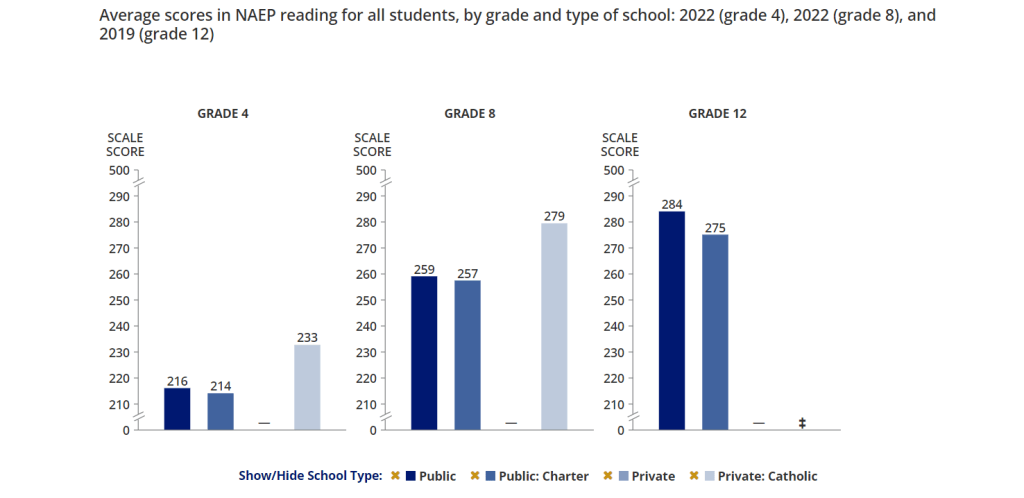
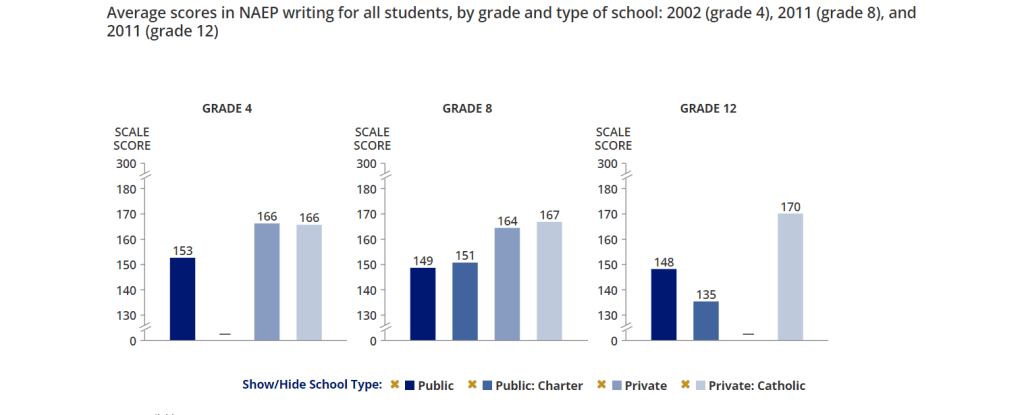
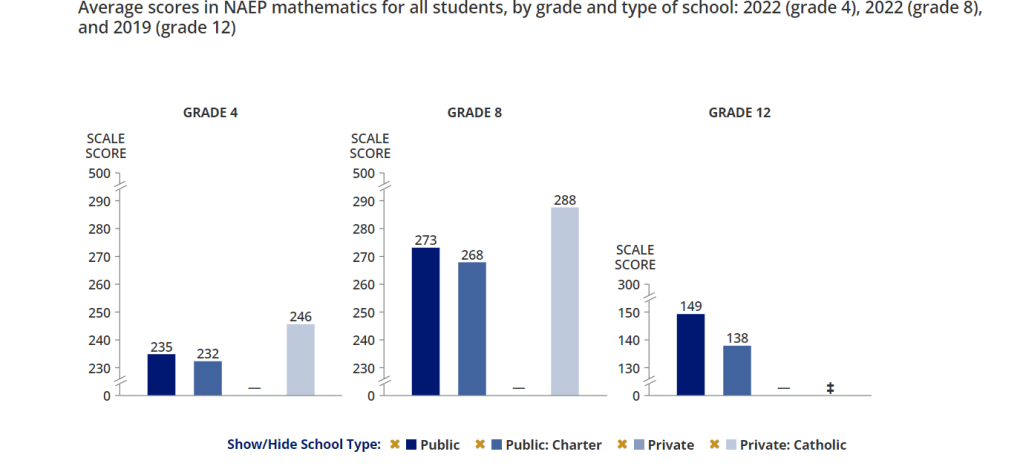
In every category, private Catholic schools score higher than both public charter and public schools. While there is limited data on non-religious private schools, they score comparably to Catholic schools and noticeably higher than public schools of both types. These test scores are from the NAEP (National Assessment of Educational Progress), a standardized test created by the government to assess the progress of students in a multitude of subjects. According to this metric, private school students are much further ahead on their educational journey than public school students as shown by the given test results, meaning that they have both learned more information and have a larger scope of knowledge. These test scores are proof that public school students are learning less successfully than students in other school models, and though many people have reservations about trusting test scores as a measure of ability, there is no better way to gauge academic progress on a wide scale at the moment. There are many factors that play into lower public test scores, such as insufficient teachers and curricula. However, additional circumstances do not change the fact that private schools are shown to teach the same subjects more effectively than their counterparts.
Though private schools may test better than public schools, academics are not always the main reason for families to choose a school; cost is a major factor as well. In states like New York, as of 2022, there were 1,047,895 students in the state (NYC.gov, “Students”). Not including teachers’ pay and school upkeep, New York alone spends over $25 billion on schooling, which is an insane amount for a mediocre education at best. Public schooling also causes high tax rates, especially in states like Alaska and New York. Keeping with New York’s data, a three-person family makes $127,000 (NYC Housing Preservation and Development) a year, paying 4.8% of their total income. Calculating these numbers, a three-person family pays roughly $6,100 in taxes for public schooling. Additionally, there are other forms of schooling that may be viable for children, such as charter schools, though the test scores are lower than that of a private school. Homeschooling may be another option, but test scores for that model are varied and may not be suitable for every child or family due to its hands-on nature. In my life, homeschooling worked well after public school, but that was only because my mother was able to stay at home and teach me, a luxury that many families do not have. Nonetheless, school choice would increase options for many families, whether they go to a private school or not.
Even with increased access to private schools via redirected tax dollars and higher prevalence of vouchers, private schools may not be for every child; no school can be a “one-size-fits-all.” Considering the major mental health epidemic in public schools, flexibility in a child’s education plan may be a factor in improving their mental state. In fact, about 1 in 6 children are considered to be at risk, or suffering from, a severe mental disorder (The Center for Disease Control). One of the main influences on a child’s risk for a mental disorder is their environment, and right now, in a time when children are away from home most of the day, that environment is school. Implementing school choice would increase diversity in the schools a child could attend, giving them more control over their environment. Moreover, school variability would allow parents to be more involved with their children and give them a bit of influence over their child’s education and mental health. Though this involvement would not necessarily increase the amount of time a parent spends with their child, it will give parents the opportunity to have a hand in one of their child’s biggest developmental factors: school. The government cannot perfectly regulate mental health in the youth, but by implementing this policy, they would be able to at least minimize the epidemic.
While the US has not tried to implement school choice on a macro scale, other countries have, such as Sweden, though they implemented it differently. Sweden has implemented a system of heavily increased private school vouchers and makes every school virtually free. However, these positives have been found to be correlated with increased social segregation and decreasing equity (Magnússon, 2019). Sweden has demonstrated that the macro goal of school choice can be accomplished, in that every child gets a well-suited education, is a good example that the implementation is far from perfected. Though there is still not a “perfect solution” for school choice, it is still a much better system than we have right now. One of the main issues in Swedish school choice is inclusion, specifically with the wording they use for those with learning issues or disabilities, which is “in need,” implying that those with issues are “lesser.” This terminology should be changed in Sweden, it can be completely avoided in the US if school choice is overseen by specialized governmental departments and implemented properly, using regulations and caution. Other instances of a policy being imperfect should not keep us from implementing a better version now, especially when the benefits are so great.
No solution is perfect. Looking throughout the world in places that have implemented school choice, they have encountered their own issues, and this case will be no different. However, considering the tragedy that is our public school system, something needs to be done. I have experienced public school, and I understand what students there are going through. Public school is a hotbed of mental health issues, unhelpful curricula, and incompetence that has not been changed in far too long. Our future will continue in this unproductive direction without first considering our children’s education. Education is a fundamental building block of our future lives, and neglecting it is both unwise and irresponsible. School choice is the most rational way to reform our public schools, and it will reap great rewards.
Works Cited
Imed Bouchrika. “U.S. Public Education Spending Statistics for 2023.” Research.com, U.S. Public Education Spending Statistics for 2023 | Research.com. Accessed 28, September 2023
Magnusson, Gunnlaugur. “Inclusive Education and School Choice Lessons from Sweden.” European Journal of Special Needs Education, vol. 35, no. 1, 2020, pp. 25–39, Full article: Inclusive education and school choice lessons from Sweden (oclc.org)
“Mental Health Symptoms in School-Aged Children in Four Communities.” Centers for Disease Control and Prevention, Centers for Disease Control and Prevention, 8 Mar. 2023, www.cdc.gov/childrensmentalhealth/features/school-aged-mental-health-in-communities.html#:~:text=A%20CDC%20study%20examined%20mental%20health%20symptoms%20in,mental%20disorder%3B%20rates%20varied%20among%20the%20different%20sites.
“NAEP Dashboards – Schools.” The Nation’s Report Card, http://www.nationsreportcard.gov/dashboards/schools_dashboard.aspx. Accessed 27 Sept. 2023.


 Everything Arts- Writing, Music and Pop culture